Five Generations of the ATM
ATM technology capability evolution — articulating the shift from simple cash dispensing to full-service digital banking terminals. Each era can be read three ways: what the machines could do, who patented the ideas, and who actually built them.
First Generation
Cash Dispensing
- ▸Single-denomination cash dispensing
- ▸Magnetic stripe card authentication
- ▸Fixed-amount withdrawals only
- ▸No screen or minimal LED display
- ▸Mechanical counters for transaction logging
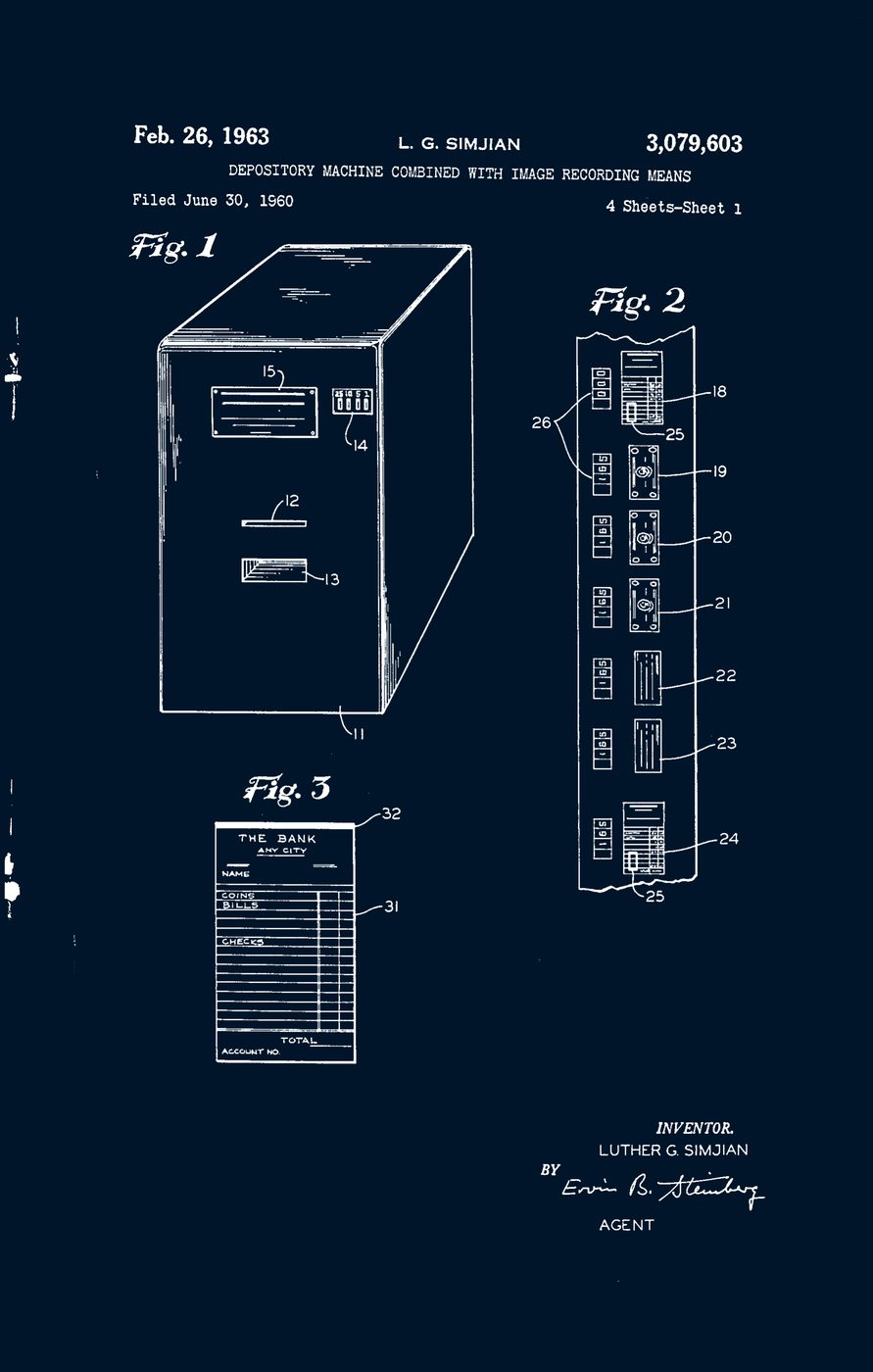
Simjian's earliest verified self-service banking filing (filed April 9, 1959): a machine activated by coded subscriber identification that validates identity and time period, then invalidates the ID against reuse. Batiz-Lazo & Reid identify this — not a mythical 1939 patent — as the real start of the Simjian record; it underpinned the 1961 Bankograph trial at a New York City bank.
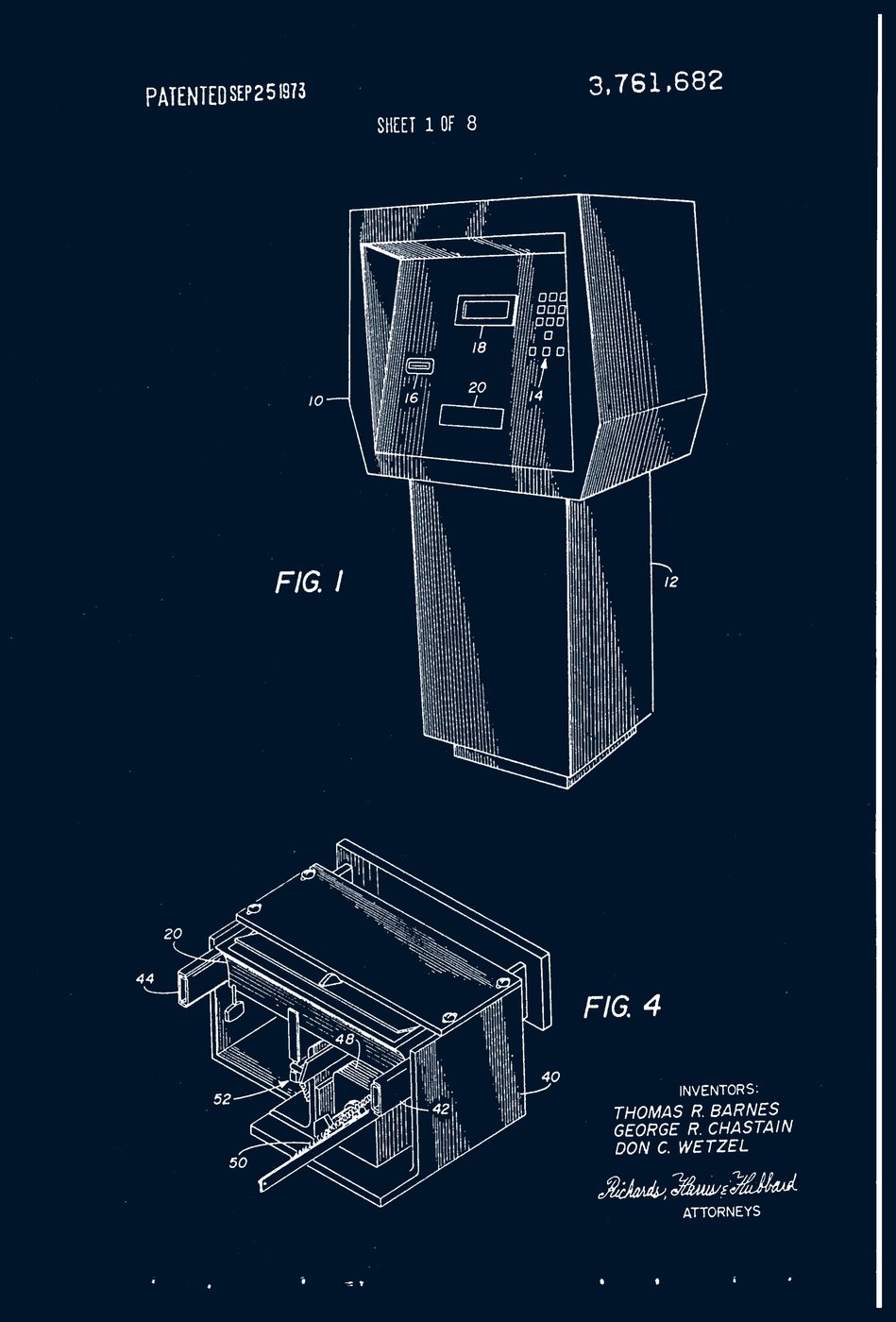
The canonical US ATM patent: Don Wetzel's Docutel team's card-actuated currency dispenser (currency packets, format/identity verification, controlled cash drawer). Anchor of the US first-generation dispensing era; part of a family with US3651986A and US3662343A.
Docutel's networked Total Teller-era system patent whose depository module — envelope transport, serial numbering device, envelope stackers — is the canonical description of first/second-generation ATM deposit: a sealed envelope, serial-stamped for audit, with zero validation of contents. The deposit is a promise, verified later by a human.
Baljevac, Serbia · Canton, USA · Dayton, USA · Dundee, United Kingdom · Higashi Sumiyoshi-ku, Osaka, Japan · Himeji, Japan · Honjo, Japan · Inagi, Japan · Irving, USA · Kita-ku, Tokyo, Japan · Linz, Austria · London, United Kingdom
See all 118 sites on the globe →Second Generation
Multi-Function Terminals
ATMs move from bank lobbies to retail locations. Triton 9500 proves small-format retail ATMs are commercially viable. The independent ATM deployer (IAD) market is born.
- ▸Multi-denomination dispensing
- ▸Balance inquiries and mini-statements
- ▸Envelope deposit acceptance
- ▸CRT displays with function keys (FDKs)
- ▸Electronic journal logging
- ▸Basic transaction sets: withdraw, deposit, balance, transfer
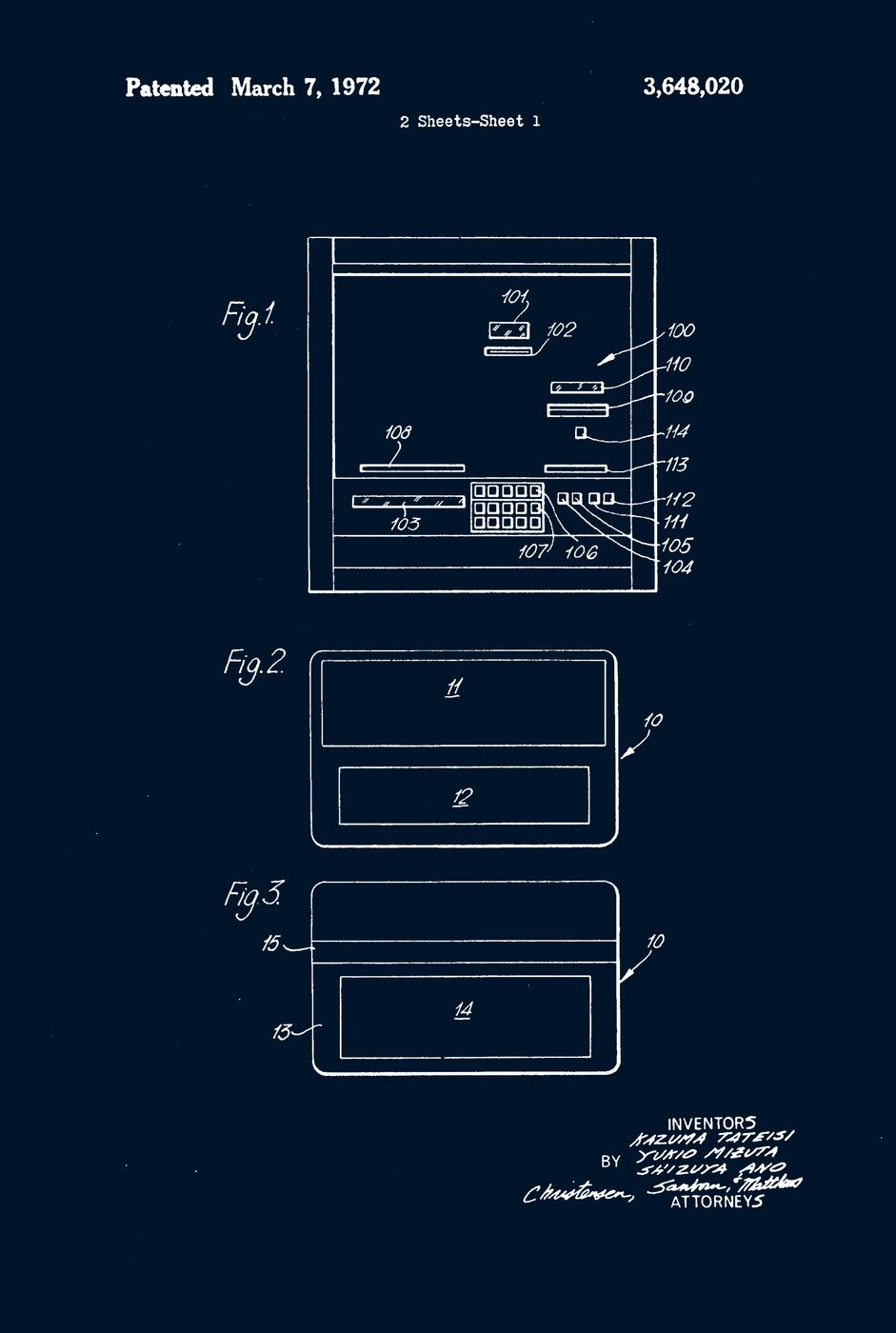
Circulation-type cash handling with mode switching (receive-only / dispense-only / both) driven by container fill levels — the operational logic that makes recycling viable without constant clerk intervention. Omron's recycling IP later merged with Hitachi's in the 2004 Hitachi-Omron Terminal Solutions JV.
Early Japanese cash-recycling patent: deposited notes are sorted by denomination into pocket sections and re-dispensed as withdrawal cash. Documents the Japanese lead (Toshiba/Hitachi/Omron/Glory) in note recycling roughly two decades before US/European deployers adopted it — deposit automation as an inventory technology, not just a customer convenience.
Hitachi's bill recycle module (BRM) family: auto-replenishes recycling boxes from a supply cassette only when the customer sensor shows nobody waiting, pausing if a customer approaches. Early evidence of Hitachi treating the recycler as an inventory-management system, not just a transport.
Carrollton, USA · Fontevivo, Italy · Fukusaki, Japan · Guangming New District, Shenzhen, China · Guangzhou, China · Gumi, South Korea · Hong Kong, Hong Kong SAR, China · Kallang, Singapore, Singapore · Lexington, USA · Lynchburg, USA · Malaga, Spain · Mexico City, Mexico
See all 118 sites on the globe →Third Generation
Intelligent Deposit & Self-Service
The ATM transforms from cash dispenser to self-service banking terminal. Intelligent deposit eliminates envelopes and provides instant credit. USB modular architecture makes components interchangeable. The independent deployer market explodes — ATMs appear in convenience stores, gas stations, bars.
- ▸Envelope-free (intelligent) deposit — cash and checks
- ▸Bulk note acceptance (50+ notes at once)
- ▸Check imaging with MICR reading
- ▸Color touchscreens with marketing content
- ▸USB peripheral architecture (modular components)
- ▸Remote diagnostics and self-healing
- ▸Surcharge-free networks (Allpoint)
- ▸EMV chip card support begins
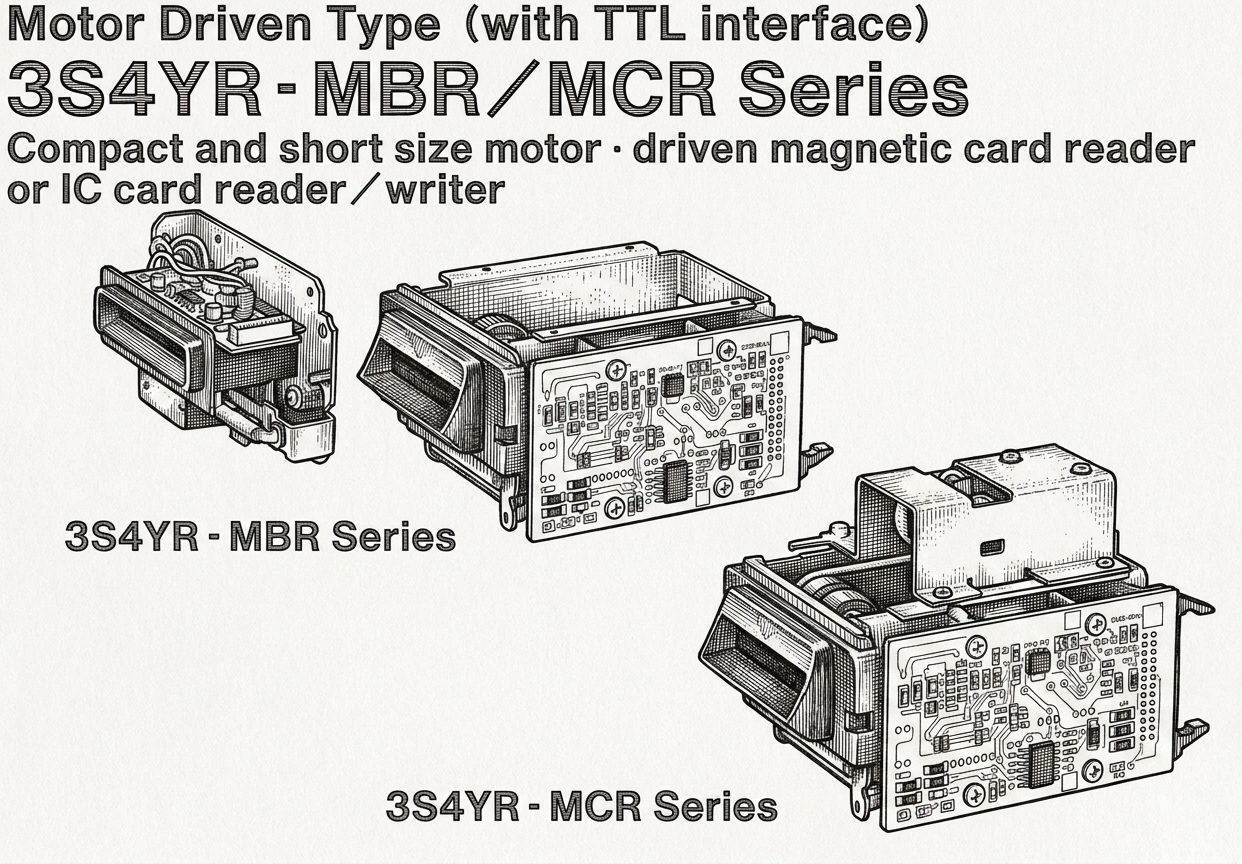
Diebold's late-1990s recycling ABM program: doubles detection, deskewing and centering of documents on a central transport that both accepts deposits (denominating and storing them) and re-dispenses them — note validation moved permanently inside the recycling path.
The foundational jitter patent: intermittent stop-start card transport during insertion/ejection so an externally mounted skimmer cannot recover a clean magnetic-stripe waveform, while the internal head reads continuously once the card is enclosed. Basis of 'jitter' anti-skimming shipped industry-wide.
Firmware-level mutual authentication between ATM components: identity-data hashing and encrypted key exchange so hardware and software components verify each other before transacting. Notable for its Brazilian inventor team — Brazil's epidemic of ATM fraud in the early 2000s made Diebold's Brazilian operation a security R&D source.
Almere, Netherlands · Bartlett (Memphis suburb), USA · Basingstoke, United Kingdom · Beijing, China · Bexbach, Germany · Binan, Laguna, Philippines · Bucheon (formerly Incheon, moved out February 2003); HQ Seoul, South Korea · Budapest, Hungary · Carrollton, USA · Cassis, France · Danville, USA · Durango, USA
See all 118 sites on the globe →Fourth Generation
Cash Recycling & Digital Banking
Cash recycling is the defining technology shift — a single machine can accept deposits AND dispense cash from the same pool, dramatically reducing CIT (cash-in-transit) costs. ITMs enable banks to extend teller hours without staffing. Branch transformation accelerates as ATMs handle 80%+ of routine transactions. The Diebold-Wincor merger (2016) and NCR split (2023) reshape the competitive landscape.
- ▸Cash recycling — deposited notes are re-dispensed
- ▸Check imaging with instant funds availability
- ▸Mixed-media deposit (cash + checks in one transaction)
- ▸Interactive Teller Machines (ITM) with live video
- ▸Contactless card (NFC) transactions
- ▸Cardless access via mobile phone
- ▸Dynamic marketing on screens
- ▸Predictive maintenance via IoT sensors
- ▸Branch transformation — ATMs replace teller windows
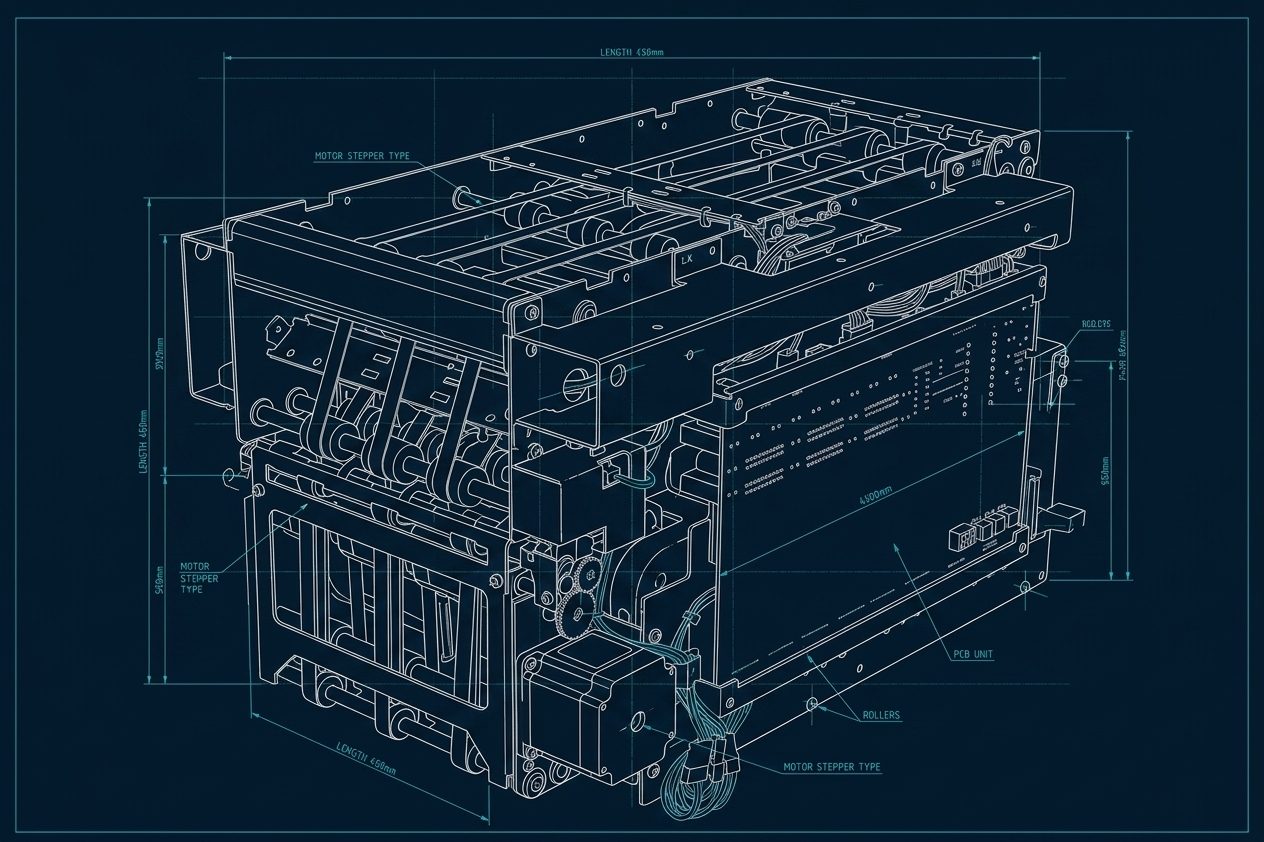
Late-stage NCR check-imaging patent: an image-based depositing ATM with dual cameras (front/rear images) that emails or web-links the acknowledgement instead of printing it. Evidence of how thoroughly the imaging core was settled by 2008 — the patentable frontier had moved to the receipt.
Nidec Sankyo's orientation-based defense: conveying the card in its short-side (width) direction with an abutting end-alignment mechanism, and detecting both longitudinal card ends to reject improper insertions that could enable illegal data acquisition — the OEM-side sibling of the 'rotate the stripe away from the skimmer' concept Diebold commercialized as ActivEdge.
Anti-internal-skimming hardware: an internal plate with pre-weakened bend/break zones blocks insertion of skimmers inside the reader throat and deliberately deforms if extracted, bricking the reader — designed against the 'deep-insert' skimmer wave that followed successful external-skimmer countermeasures.
Alpharetta, USA · Basingstoke, United Kingdom · Columbus, USA · Glostrup (Copenhagen area), Denmark · Greensboro, USA · Guangdong (municipality not specified), China · Haiphong, Vietnam · Hyogo prefecture (exact plant address not located), Japan · Kazo, Japan · Manaus, Brazil · Sao Paulo state (municipality not established), Brazil · Sao Paulo, Brazil
See all 118 sites on the globe →Fifth Generation
Connected Self-Service Ecosystem
The ATM becomes a node in a connected banking ecosystem rather than a standalone device. ATM-as-a-Service shifts from CapEx to OpEx. AI-driven predictive maintenance reduces downtime to near-zero. Cash recycling is now standard, not premium. The competitive landscape consolidates: NCR Atleos (58% global share), Diebold Nixdorf (post-bankruptcy restructuring), and Hyosung Innovue are the big three. Component suppliers like Glory, Hitachi-Omron, and Nidec Sankyo remain critical to the supply chain.
- ▸ATM-as-a-Service (subscription model)
- ▸Cloud-native software platforms
- ▸AI-powered predictive maintenance
- ▸Biometric authentication (palm, iris, facial)
- ▸Cryptocurrency/Bitcoin ATM convergence
- ▸Open banking API integration
- ▸Video-assisted self-service at scale
- ▸Sustainability focus (energy efficiency, reduced cash handling)
- ▸Windows 11 IoT Enterprise
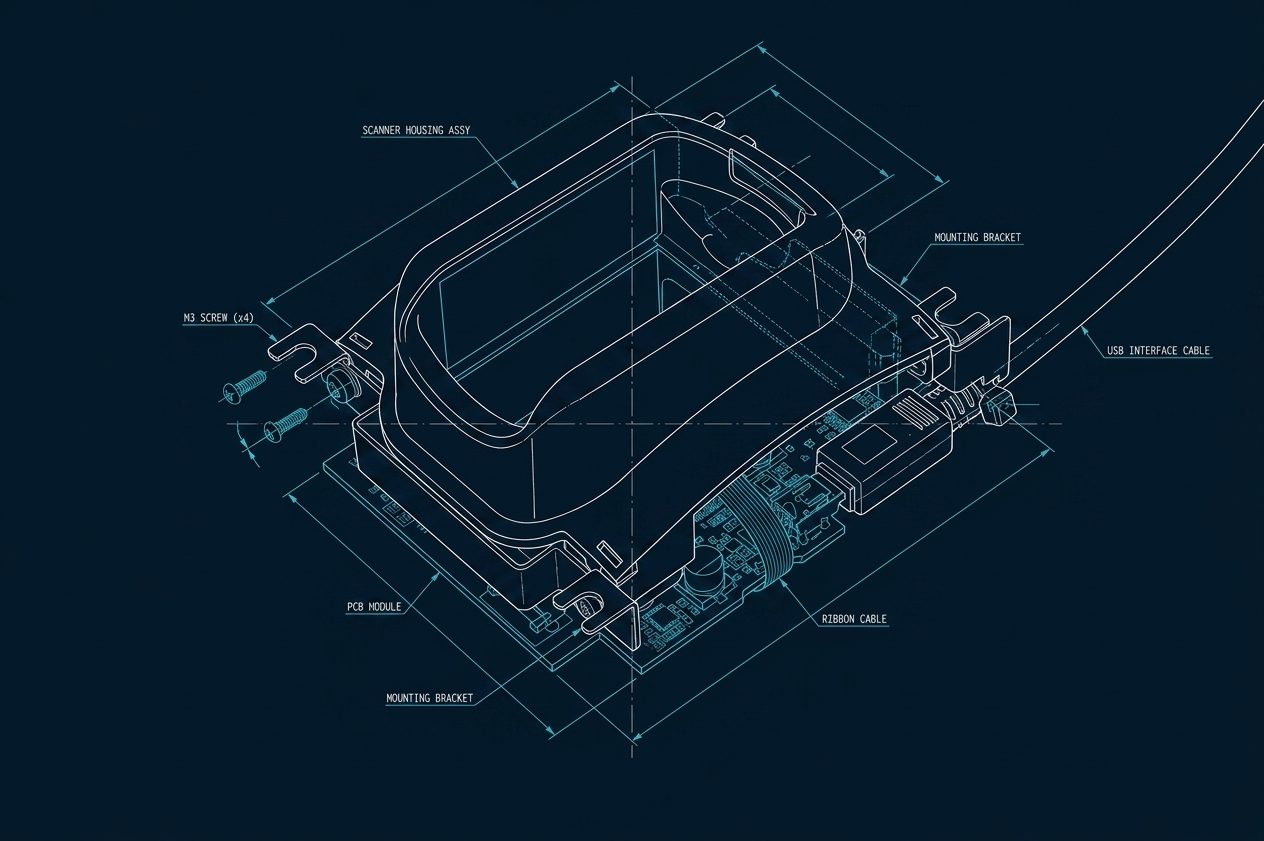
The dominant OEM absorbing the anti-skimming stack into the reader itself: a disturbing-magnetic-field (jamming) generator built into the card reader, with soft-adhesive-filled gaps between core/bobbin/board/housing to suppress the audible vibration noise jamming coils cause — a manufacturability refinement showing jamming is now a standard integrated subsystem.
Current state of the art on file: multiple ML models trained on terminal telemetry compete, the best is deployed, and models continuously retrain -- explicitly covering ATMs among self-service terminals. Shows predictive maintenance moving from threshold rules (2009-2011 filings) to MLOps. Status: pending as of verification (2026-08).
Binan, Laguna, Philippines · Markersdorf, Germany · Velbert, Germany · Verona, Italy
See all 118 sites on the globe →Who Actually Builds an ATM
The brand on the fascia rarely made what is behind it. Component supply chains traced across the five generations.
Component Evolution Tracks
Assembled from the atmavailability research corpus: Wayback Machine archives of 20 manufacturers, ~110 patents verified against Google Patents, a 118-facility manufacturing registry built from SEC filings, newspaper archives and corporate histories, and component supply-chain analyses. Sources and confidence levels: research/analysis/.
Same research, different axis
Inside the ATM
Nine components, each opening onto the patent that defines it, the companies that actually manufacture it, and how it changed across these five generations.
ATM Makers of the World
118 documented manufacturing sites across 27 countries on a globe — invented in three places at once, migrated to Asia, consolidated to near-single-source.