Inside the ATM
Take a cash machine apart and you find nine problems, each solved by a different company, most of which you have never heard of. Every part here opens onto the patent that defines it, the firms that actually manufacture it, and how it changed across five generations.
Fascia & Housing
The only part with a logo on it, and the least likely part to have been made by that company.
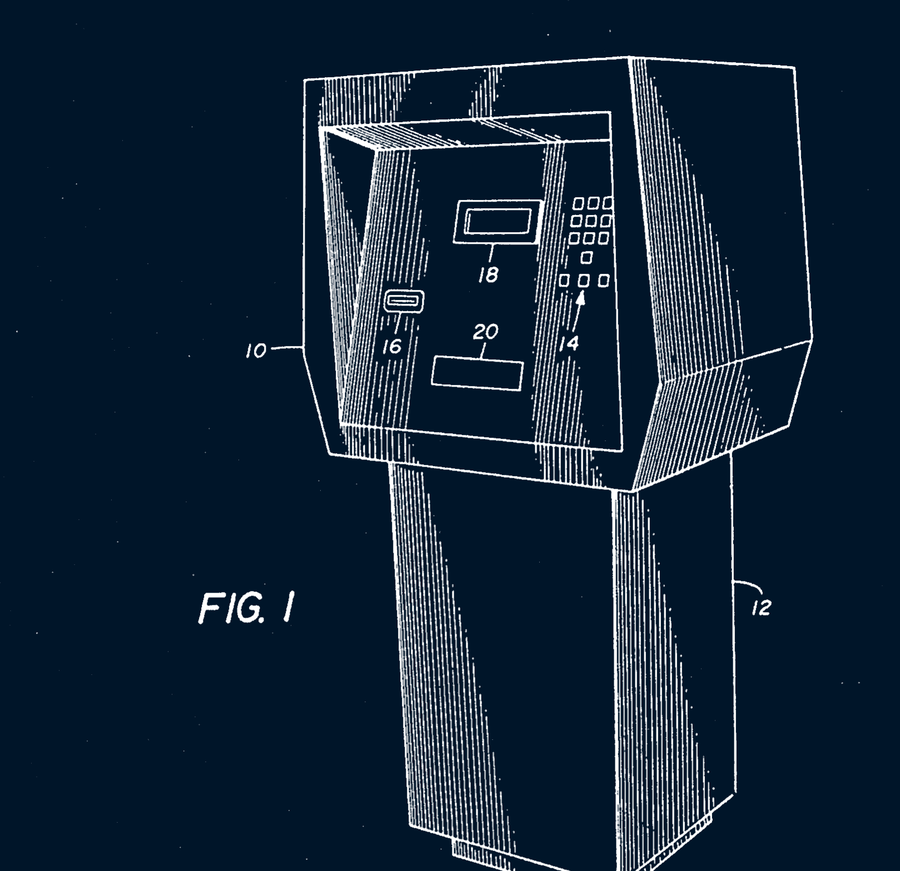
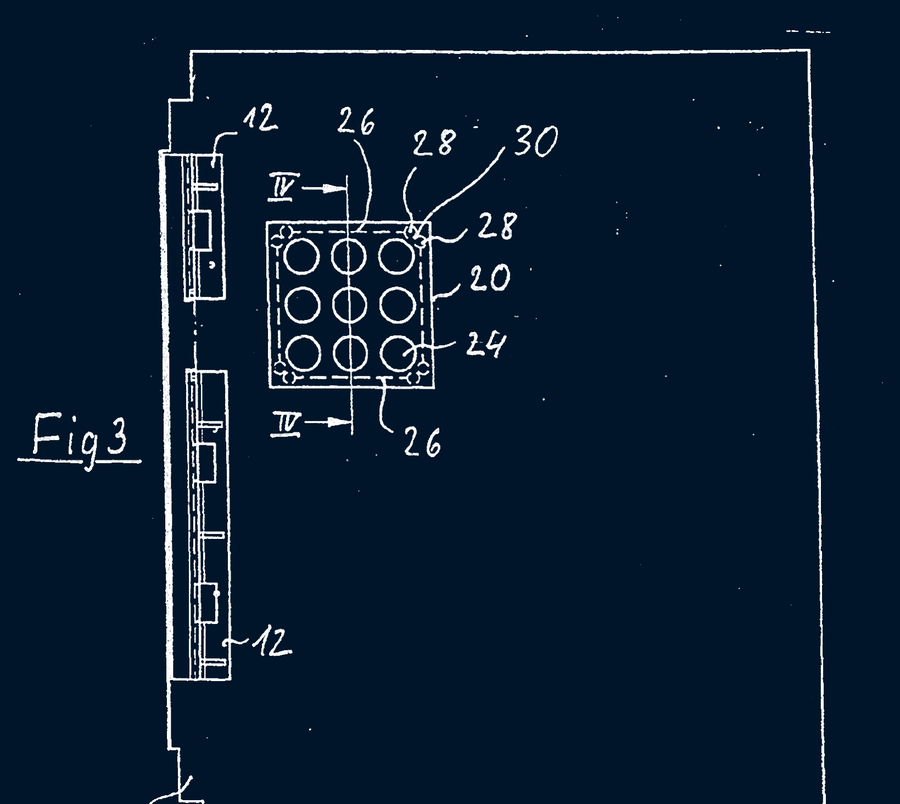
US 3,761,682 — Credit card automatic currency dispenser. The Docutel cabinet, the machine that put an ATM on an American street.
Docutel Corporation, granted 1973 · read the patent
The fascia is the machine as far as almost everyone is concerned: a cabinet, a screen, a slot, a brand. It is also the thinnest claim in the whole assembly. The research behind this page went looking for who builds each module inside an ATM and kept arriving at the same answer — a handful of specialist suppliers, most of them Japanese, most of them invisible, none of them the company whose name is on the front.
What the cabinet genuinely is: a weather envelope, a security boundary, and an ergonomic problem. It has to survive a car park, resist somebody attacking it with hand tools long enough for a response, and still let a person of any height reach the keypad. The five generations of shapes in this gallery are five different answers to that, from Docutel's 1973 upright box to a modern frame built around a portrait touchscreen.
Display & Interface
From no display at all, to a CRT with keys down the side, to glass that has to work in direct sunlight for someone who cannot see it.
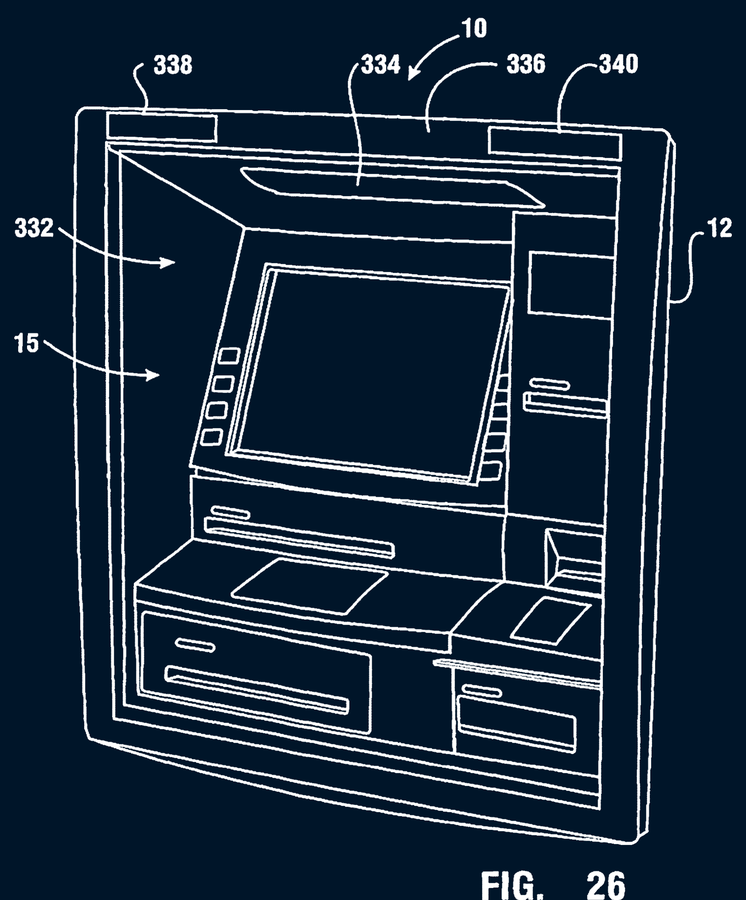
US 9,990,614 — Tactile touch screen. Touch had to be made usable without sight before it could replace the physical keys beside the glass.
Diebold Nixdorf, granted 2018 · read the patent
The first cash machines had nothing worth calling a display. What replaced it — a CRT flanked by function display keys — became so completely the idea of an ATM that the layout survived thirty years and outlived the tube itself.
Two constraints shaped everything after that, and neither is obvious from a desk. An ATM screen is read outdoors, so sunlight readability is a purchasing specification rather than a nicety, and a whole aftermarket exists to retrofit brighter panels into installed machines. And when touch replaced physical keys, it broke the machine for blind users, which is why a patent for a tactile touch screen — one you can feel your way around — sits at the top of this gallery.
- NCR (Dundee) — integrator, display-interface pioneerATM integrator; drove the CRT+color+FDK interface standard in the 1980s and the large-format 'Infinity' multi-touch standard in the 2010s1977-present · high
- Zytronic plc (Blaydon-upon-Tyne, UK)Vandal-resistant projected-capacitive (PCT) touch sensor supplier to the ATM industry; self-described NCR supplier ('NCR relies on proven Zytronic touchscreen technology'). Wound down: factory closed May 2025, delisted from AIM May 2025~2000s-2025 · medium (Zytronic's own marketing + financial filings; NCR-side confirmation not found)
- Elo Touch Solutions (ex Elographics / Elo TouchSystems)Inventor of the 5-wire resistive transparent touchscreen (AccuTouch, 1974); dominant resistive-touch component supplier for self-service/kiosk/POS through the 1980s-2000s1971-present · high for the technology history; low for named ATM OEM design wins (none verified)
- Display Concepts (SunView line, acquired from Palomar Displays 2007)Aftermarket/retrofit supplier of sunlight-viewable ATM monitors — drop-in replacements for 10" CRTs and early 8.4" LCDs across all four major ATM makes2000s (article 2009) · high (trade press)
- Litemax Electronics (Taipei)Sunlight-readable / high-brightness (800-2000 nit) industrial LCD maker explicitly listing ATMs as a core market2000-present · medium (vendor marketing; no named ATM OEM win verified)
Who buys from whom (3)
- NCR buys from ZytronicProjected-capacitive vandal-resistant touch sensors for ATM/self-service terminalsmedium (asserted by Zytronic marketing/filings; not confirmed from NCR side)
- NCR / Diebold / Fujitsu / Wincor Nixdorf (installed base, aftermarket) buys from Display Concepts (ex Palomar Displays SunView line)8.4" sunlight-viewable LED-backlit LCD retrofit monitors replacing 10" CRTs and early 8.4" LCDshigh
- Retail ATM channel (Hyosung/Genmega installed base) buys from Third-party ATM parts channel (NextATM, ATMPartMart, CORDatm, Empire ATM Group, etc.)Replacement LCD panels, touch overlays, and AD (display-driver) PCBs sold by machine model rather than by panel makerhigh (parts listings observed)
- 1970s-1980sLED matrix or no display
- 1980s-1990sCRT monitors with function display keys (FDKs)
- 1990s-2000s10-12" color LCD, function keys beside screen
- 2000s-2010s15" touchscreens replace physical FDKs. Color marketing displays
- 2010s-present15-19" HD Infinity Displays, dynamic marketing upper panels, ambient sensors
Card Reader
One Japanese company builds roughly four fifths of these. Almost nobody outside the industry has heard of it.
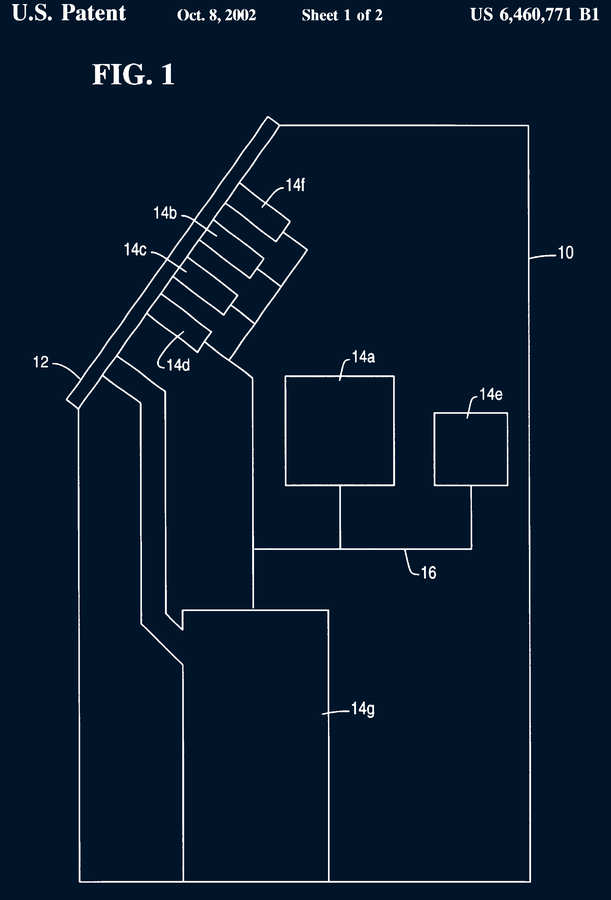
US 6,460,771 — Motorized card reader module. The foundational anti-skimming patent: move the card unevenly, and a stripe reader taped to the throat cannot decode it.
NCR Corporation, granted 2002 · read the patent
The card slot is the most concentrated part of the whole supply chain. Sankyo Seiki — Nidec Sankyo from 2005, Nidec Instruments from 2023 — built its first magnetic card reader in 1971 and aimed it at cash machines. It now claims about 80% of the readers built into the world's ATMs. Part-number archaeology across three competing bank-ATM brands keeps surfacing the same Sankyo motorised family behind all of them.
It is also where the security arms race is most visible in the mechanism itself. A skimmer is a reader taped to the throat of the real one; the counter-measure is to move the card unevenly as it goes in, so the parasite gets an unreadable signal. That is a jitter drive, and there is a patent for it. Later readers add shutters against fishing, encrypted read heads, and contactless.
- Sankyo Seiki Mfg. -> Nidec Sankyo Corp. (2005) -> Nidec Instruments Corp. (April 1, 2023)Dominant merchant OEM of ATM card readers; self-claims ~80% share of card readers built into ATMs. Developed its first magnetic card reader in 1971 and focused on readers for ATM systems. Nidec Corporation became majority shareholder in 2003.1971-present · high for product families and corporate history (company pages, Wikipedia, Triton primary bulletins); medium for the 80% share figure (company self-claim)
- Omron -> Hitachi-Omron Terminal Solutions (JV, operating by Oct 2004) -> Hitachi Channel SolutionsThe other major Japanese merchant OEM of ATM card readers; Omron's 3S4YR family and successor V-series covered swipe, insertion, and motorized hybrid (magnetic+IC) readers for ATMs, CDs, kiosks, and POS. Sold through the worldwide Omron sales network.ca. 1980s (Omron 3S4YR family) - present · high (primary Wayback captures of hitachi-omron-ts.com in local corpus)
- MagTekUS maker of magnetic swipe/dip readers; supplied EMV-capable dip readers (I-65, 'CORE') to Triton until 2013, when Triton dropped them ('Magtek EMV Card Readers are not supported in the US Market') in favor of Nidec Sankyo ICM330.ca. 1990s-2013 (in Triton ATMs) · high (Triton primary service bulletin)
- KYTronics (Korea) — probable maker of the TDR-R240NSupplier of the TDR-R240N EMV dip reader that 'now comes with Genmega and Hantle ATMs' and is the standard GenMega/Hantle EMV field-upgrade reader. Attribution to KYTronics is inferred from a reseller SKU slug ('mcr-assy-emv-type-kyt-7916').ca. 2015-present · medium that TDR-R240N is the GenMega/Hantle standard reader (multiple resellers); low on KYTronics as its manufacturer (single URL-slug inference)
- GenMega (integrator; readers bought in)Retail/off-premise ATM maker whose spec sheets across 2011-2023 show the retail segment's reader trajectory: dual-head swipe (G1900, 2011, 'upgradable to DIP and EMV') -> 'DIP Type card reader, EMV Optional' (2011-2015) -> 'EMV (DIP type)' standard (2015-2023). Never motorized in this segment.2011-present · high (primary Wayback captures in local corpus)
Who buys from whom (8)
- Triton buys from MagTekI-65 dip reader / CORE EMV readerhigh
- Triton buys from Nidec SankyoICM330 EMV dip reader ('EMV 330') — upgrade kits for RL16/23/53, ARGO X2, RL51, Traverse, FT51/RT21, FT53/RT23, 8100/9100 (2014), 9600/9700 (2015); FT53 shipping EMV-ready with Sankyo reader from 2013-08-16high (primary Triton technical bulletins 13-23 and 14-10, both fetched and text-extracted)
- NCR buys from Nidec SankyoU-IMCRW motorized reader (NCR PN 445-0704482 = Sankyo ICT3Q8-2R1A0345), used across SelfServ 66xx (6622/6625/6626/6632/6634/6683/6684/6688 etc.)medium (multiple independent aftermarket cross-references of NCR PN to Sankyo model; no NCR primary document)
- Diebold (Opteva) buys from Nidec SankyoOpteva motorized smart card readers 49-209540-000B/C/F and 49-209542-000F cross-referenced to Sankyo ICT3Q8-3A2761medium (multiple aftermarket listings identify the Opteva reader as Sankyo ICT3Q8; no Diebold primary document)
- Nautilus Hyosung buys from Nidec SankyoICT3Q8-3HT2290-S motorized smart card reader (Hyosung PN S5645000062) for financial-series ATMsmedium (aftermarket part cross-reference)
- GenMega / Hantle buys from TDR-R240N maker (probably KYTronics)TDR-R240N EMV dip reader — factory reader and EMV field-upgrade kit for G1900/G2500/GT3000/GT5000/Onyx/G6000/C6000 and Hantle modelsmedium for the relationship; low for the maker's identity
- Wincor Nixdorf buys from Hitachi-Omron (inferred from V-series naming lineage)'CHD V2CU' USB 3-track smart card reader (Wincor PN 01750173205) on ProCash 280/280N/285 and Cineo C4060 — the V2C USB variant naming matches Hitachi-Omron's V2A/V2B/V2C/V2X motor-driven family documented in the corpuslow-medium (inference from model nomenclature + corpus V2C documentation; aftermarket listings brand it only as Wincor)
- Triton (ARGO 7/12/15, ARGO FT, RL1600/RL2000/RL5000 X2, FT5000 X2) buys from unnamed in sourceAdvanced Anti-Skim Card Reader (2019-2021): metal detection of mounted skimmers with auto out-of-service + Triton Connect alert, magnetic-field jamming, encryption at the magnetic head, encryption of EMV APDU on the reader cable; ISO 7810/7811/7813 tracks 1-3, EMV 3.1.1/4.0, cites PCI ATM Guidelines v1.0 s4.1.2.khigh for the product and features (primary capture); supplier not stated
- 1960s-1980sManual dip/swipe magnetic stripe readers
- 1980s-2000sSankyo motorized readers become industry standard (MCR/ICM series). Card capture capability
- 2000s-2010sEMV chip readers added. Anti-skimming: jitter movement, encrypted read heads
- 2010s-presentNFC contactless combo readers (Nidec Sankyo). Card-less via QR/NFC mobile. Anti-shimming protection
Encrypting PIN Pad
A sealed cryptographic device that erases its own keys if you open it — and the reason a number in your head guards your money at all.
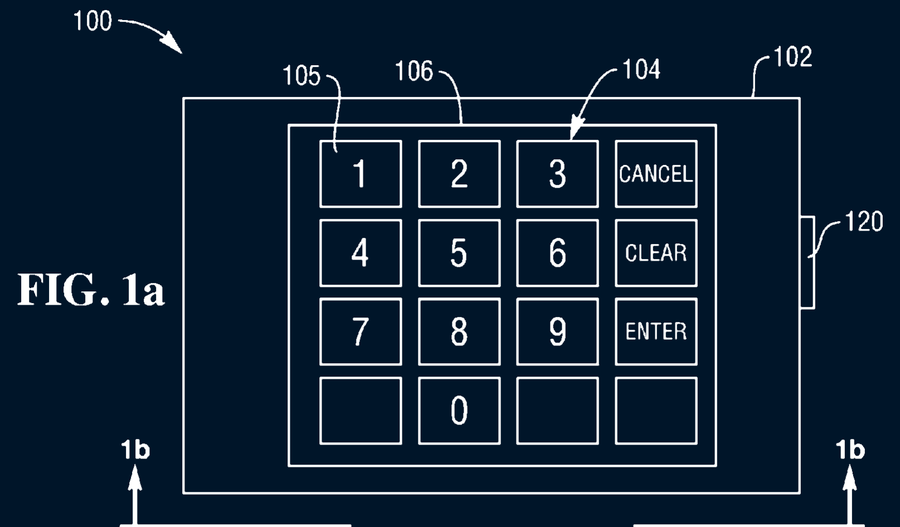
US 9,430,675 — Encrypting PIN pad. By this point the keypad is a sealed cryptographic device that destroys its own keys if opened.
NCR Corporation, granted 2016 · read the patent
The keypad is the part that had to be invented before any of the rest made sense. Somebody had to decide that a short number a person could remember was enough to authorise a stranger's machine to hand over cash. The patent for that idea is in this gallery, filed in 1967 by Anthony Davies and James Goodfellow at Chubb.
Everything since has been about making the pad itself untrustworthy to attack. A modern EPP is a tamper-responsive module: drill it, freeze it, or lift its lid and it destroys its keys rather than reveal them. It is certified under PCI PTS, and the certification expires, which quietly forces hardware refreshes across entire estates on a schedule set by a standards body rather than by the bank.
- Cryptera A/SThird-party EPP OEM — the dominant independent EPP specialist (Denmark, founded 1984)1984-present; first EPP deployment 1994 (GeldKarte, Germany), first ATM EPP installs 1995 (Germany) · high
- NCRVendor-proprietary — designs its own EPP modules for its ATM lines (EPP-2/EPP-3/EPP-4 generations, 445-xxxxxxx part numbers)DES-era proprietary pads (1980s) through PCI-era EPP-3/EPP-4 modules; Dundee ATM manufacturing ended May 2009 · medium
- Wincor Nixdorf (later Diebold Nixdorf)Vendor-proprietary EPP line (EPP V5/V6/V7/V8, 'J6' variants); V8-era units carry Cryptera manufacture markings after the 2016 Diebold mergerEPP V5/V6 in ProCash era (2000s); EPP V7 (2010s); EPP V8 current · medium
- Diebold (later Diebold Nixdorf)Integrator that sourced EPPs from Cryptera (from at least 2005), then bought the supplier outright (June 2014)Cryptera-supplied PCI EPPs from 2005; owner of Cryptera 2014-onward · high
- SZZT Electronics (Shenzhen Zhengtong)Third-party EPP OEM and aftermarket supplier (China); claims first Asian maker with Visa-certified ATM EPP (2005) and PCI-certified 2006 (4th globally)2005-present · medium
Who buys from whom (6)
- Diebold buys from CrypteraPCI PED approved EPPs for Diebold US ATMs ('first PCI PED approved EPP for Diebold (US) ATMs', 2005)high
- ARCA buys from CrypteraEPP 1215 / 1217 / 1218 / 2200 sold through ARCA's OEM components cataloghigh
- Diebold Nixdorf (Wincor-heritage ATMs) buys from CrypteraWincor EPP V8 (aftermarket units marked 'CRYPTERA', e.g. PN 01750303455)medium
- Wincor Nixdorf installed base (aftermarket) buys from SZZT ElectronicsZT596F sold as EPP V6 replacement for C4060 / ProCash 280 / 8000 / 8100medium
- Wincor/Diebold-Nixdorf installed base (aftermarket) buys from JusttideE6020 / E6021 (J6-form-factor) PCI 5.0 EPPs with TR-34 remote key loadingmedium
- Zytronic (touch sensor) + ATM/kiosk OEMs buys from CrypteraPCI-compliant touchscreen PIN entry (encrypted touch controller + secure touch sensor)medium
- 1970s-1990sMechanical keypads → DES encrypted PIN pads
- 1990s-2010sTriple-DES, PCI PTS certified. Major suppliers: Wincor, NCR, Diebold proprietary
- 2010s-presentAES-256, PCI PTS 5.x/6.x. Touchscreen EPP emerging. PIN-on-glass in pilot
Receipt Printer
The one module the big integrators mostly did keep in-house.
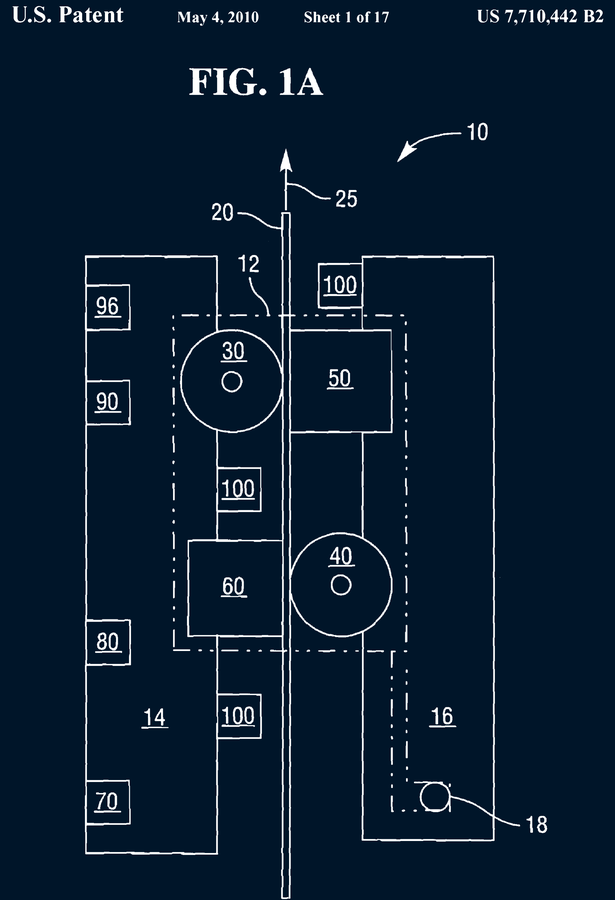
US 7,710,442 — Two-sided thermal print configurations. Printing both sides at once halves the paper an ATM estate gets through.
NCR Corporation · read the patent
Receipt printing is the exception that makes the rest of the supply chain legible. Where card readers and note handling went out to Japanese specialists, the integrators largely kept receipt printers: NCR shared engineering with its retail point-of-sale printer line, Wincor Nixdorf ran its own needle and thermal families, Diebold engineered its own.
The technology arc is short and total — impact, then dot matrix, then thermal, with two-sided thermal arriving late to halve the paper an estate consumes. The interesting survival is impact printing, which held on far longer than it should have in exactly one place: passbooks, which have to be struck rather than heated.
- NCRATM integrator with in-house receipt-printer engineering (POS printer heritage); consumables via Systemedia1st gen (1977 NCR 770) through 5th gen · high (corpus primary captures for SelfServ claims); medium for 2ST/RealPOS lineage
- Diebold (incl. InterBold JV with IBM, 1990s)ATM integrator; engineered its own journal-printer supervision (paper-feed fault detection)2nd–3rd gen · high (USPTO patent record)
- Wincor Nixdorf (Siemens Nixdorf heritage; now Diebold Nixdorf)ATM integrator with its own family of needle (dot-matrix) and thermal printer modules2nd–4th gen · medium (aftermarket part listings for ND/NP/TP families); high for ProCash 2000 claim (corpus primary)
- Hitachi-Omron Terminal SolutionsOEM module supplier — sells printer modules (alongside card readers, finger-vein readers) for third-party integration3rd–4th gen (captures 2009–2010; pages archived through 2020) · high (corpus primary captures of hitachi-omron-ts.com)
- OKI (Oki Electric Industry / OKI Data)Dot-matrix printing heritage (Microline line) and full-ATM maker (cash-recycling ATMs for Japan since 1982; ATM-Recycler G7 2009, G8 2017). NOT evidenced as a receipt-mechanism supplier to other ATM makers.2nd gen (Japan recyclers, 1982) through 5th gen (G8, emerging markets) · medium (vendor press releases and corporate history via search; oki.com history page itself returned 403)
Who buys from whom (5)
- third-party ATM/kiosk integrators (unnamed) buys from Hitachi-Omron Terminal SolutionsPBM BH188S-S / PEM BH180A-S impact dot-matrix passbook printer modules (RS232C/USB 'for versatile connection with the host')high that modules were sold for integration; no named customer verified
- Wincor Nixdorf ProCash ATMs buys from Wincor Nixdorf (in-house ND/NP needle and TP thermal printer families)ND98/ND98D/NP06 journal printers; ND9E/ND9A/NP07 receipt printers; TP07 thermal receipt printermedium (part-number families from aftermarket listings; in-house origin inferred from Nixdorf part numbering)
- NCR SelfServ ATMs/ITMs buys from NCR (in-house, shared with RealPOS retail printer line)2ST two-sided thermal receipt printer; dual-roll thermal receipt printersmedium (NCR datasheet + NCR-branded ATM part numbers, e.g. 009-0032473, 009-0026666)
- IBM / Embross boarding-pass kiosks (adjacent self-service market) buys from Swecoin (TTP 2100)Thermal ticket printerlow (single secondary source, kioskindustry.org retrospective)
- Gilbarco Veeder-Root outdoor payment terminals (adjacent unattended-payments market) buys from Hengstler (eXtendo X-56 / X-80)Direct thermal receipt printersmedium (Hengstler's own case statement)
Cash Dispenser & Recycler
Separating exactly one banknote from a stack, thousands of times a day, without tearing it.
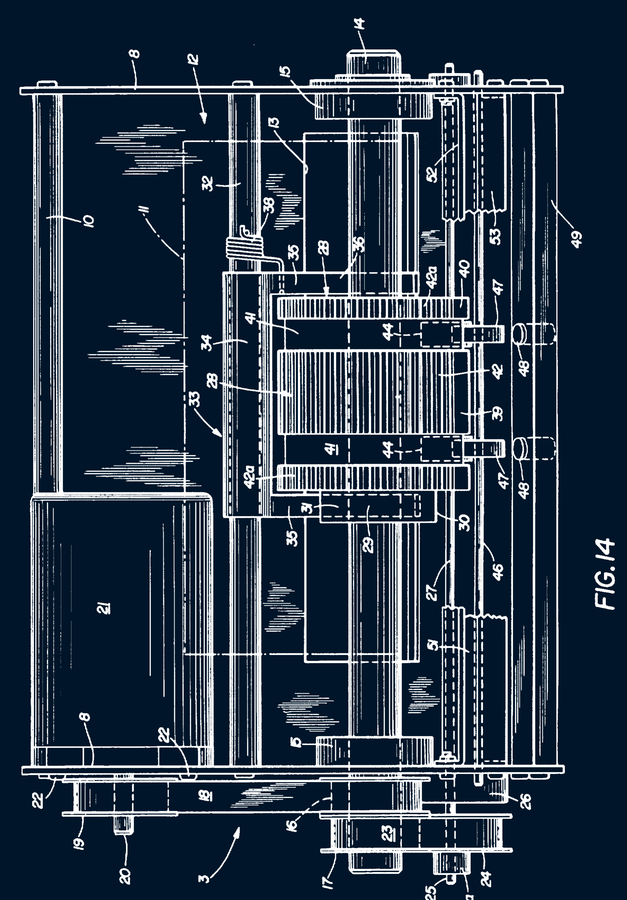
US 4,494,747 — Paper currency dispenser friction picker mechanism. The wheel that presses on the top of the stack and pulls a single note off it.
Diebold Incorporated, granted 1985 · read the patent
This is the hard mechanical problem, and the one the industry has never fully brought in-house. De La Rue was feeding and counting notes mechanically before anyone put a machine outside a bank, and it supplied the dispensers other people's ATMs were built around — a lineage that ran through Talaris and ended inside Glory. Notes are limp, dirty, stuck together and inconsistent between countries; a picker that works on crisp US dollars is not a picker that works on old rupees.
The generational break is recycling. A recycler takes deposits and pays the same notes back out, which collapses the deposit module and the dispenser into one machine and cuts the cash-in-transit runs that dominate the running cost of an estate. Japan got there first — OKI in 1982 — and Western makers mostly bought the module in rather than build it. Wincor Nixdorf is the notable exception that kept recycling in-house.
- De La Rue Cash Systems (-> Talaris 2008 -> Glory 2012)Independent merchant mechanism maker; the original ATM dispenser supplier (Barclays/De La Rue 1967)Gen 1-3 (1967-2008) as De La Rue; brand names live on inside Glory · high
- NCR (Dundee, Scotland; plant closed 2009, manufacturing relocated)Vertically integrated integrator - designs and builds its own dispense mechanismsGen 2-5 (5070 developed at Dundee, 1983; S2 dispense modules current) · high
- Diebold (pre-merger)Vertically integrated integrator for dispense-only mechanisms; OEM buyer for recyclingGen 2-4 (i Series 1991 -> Opteva 2003-2016) · high
- Wincor Nixdorf (-> Diebold Nixdorf 2016)Vertically integrated integrator - the one Western maker that kept recycling engines in-houseGen 3-5 (ProCash recycling pages live by 2002; CINEO 2010s; DN Series RM4 current) · high
- Fujitsu (Fujitsu Frontech)Merchant mechanism maker - compact dispensers for kiosks/retail ATMs; NCR deposit-module part numbers carry Fujitsu KD0-prefix codesGen 3-5 · high
Who buys from whom (7)
- NCR buys from GloryBRM-10 banknote recycling module (SelfServ 83/87 BRM-class recyclers, 6683/6687)medium-high (parts-market listings and refurbisher catalogs name the pairing explicitly; no NCR/Glory press release found)
- NCR buys from Fujitsu (inferred)GBNA bunch note acceptor / GBRU bunch recycling unit (SelfServ 34/36, 6634) - GBRU parts carry Fujitsu-format KD0xxxx part numbers and refurbishers catalog them as 'NCR Fujitsu GBNA GBRU'medium (part-number forensics + reseller naming; no primary NCR/Fujitsu statement found)
- Diebold (pre-merger) buys from Hitachi-Omron Terminal SolutionsUniversal Recycler (TS-M1U1) inside Diebold ECRM/BCRM enhanced cash recyclers; matches Hitachi-Omron UR-series modules in corpusmedium-high (parts market names 'Diebold Hitachi-Omron ECRM' explicitly; corpus documents the UR module line)
- Diebold Nixdorf (post-2016) buys from in-house (Wincor heritage)RM3/RM4 recycling engines (RM4H, RM4V) in DN Series - direct descendants of Wincor's CMD/CINEO recycling linehigh
- Triton buys from De La Rue -> TalarisSDD, MiniMech, NMD 50, NMD 100 across the 9xxx/RL/FT lineshigh
- Kiosk/self-service builders via ARCA (distributor) buys from Fujitsu, Diebold, MFSF53/F56, F510, Diebold AFD, MFS CDM-4000 sold as OEM componentshigh
- Various self-service integrators buys from GloryOEM catalog: RBW-100/RCW-100 recycling, NMD-100/NMD-50/MiniMech/MultiMech dispensing (ex-De La Rue designs)high
- Hitachi-Omron Terminal Solutions (now Hitachi Channel Solutions; US arm was Omron Transaction Systems, Schaumburg IL)Merchant OEM maker of banknote validation + recycling modules; the dominant recycling-module supplier to Western ATM integrators2004-present (Hitachi recycling lineage older, Japan) · high
- Fujitsu (Fujitsu Frontech)Merchant OEM maker of bill recycling/acceptance units and dispensers; NCR's recycling-module supplier1990s-present (OEM dispensers); GSR50 era 2014-present · high
- Glory (Glory Global Solutions after acquiring Talaris 2012)Note validator and OEM deposit/recycling module maker; consolidated the ex-De La Rue OEM mechanism business1990s-present as validator maker; OEM module line documented 2019-2024 · high
- De La Rue Cash Systems (became Talaris 2008 under Carlyle; absorbed into Glory 2012)OEM dispensing/deposit mechanism supplier of the 2nd-3rd generations; named alongside Glory and Hitachi as bulk-note-acceptor supplier of the intelligent-deposit era1967-2008 (as De La Rue) · high
- GRG Banking (Guangzhou)Integrator that also sells its acceptance modules as a merchant OEM line (banknote acceptors, recyclers, cash+check deposit modules) to kiosk, AFC and self-service integrators2003-present; OEM module line documented 2015-2019 · high
Who buys from whom (8)
- Diebold buys from Hitachi-Omron Terminal SolutionsECRM/BCRM cash recycling machines incl. bill validator (ZBV1R) and Universal Recycler (TS-M1U1)high
- NCR buys from Fujitsu FrontechGSR50 Scalable Cash Recycler / GBRU Global Bill Recycling Unit (NCR part 497-0522696; NCR publishes GSR50 install kits)high
- NCR buys from NCR (in-house, Dundee/Waterloo engineering)GBNA bunch note acceptor and SDM scalable deposit module (single-slot mixed cash + check with imaging/MICR)high
- Diebold buys from Diebold (in-house)IDM intelligent depository (check imaging + MICR any-orientation) and Opteva BNA/ENA bulk note acceptor (100 notes)high
- Wincor Nixdorf buys from CI Tech Components AG (JV: Wincor Nixdorf + Giesecke & Devrient, announced 2011-01-20)Banknote authentication sensors / banknote readers for cash-in and recycling moduleshigh
- Genmega (kiosk products) buys from MEI (Crane Payment Innovations)Single-note bill acceptors in deposit-enabled kiosks / sidecarsmedium
- ARCA buys from Fujitsu FrontechF53/F56, F510, F50 OEM dispenser mechanisms resold/integrated by ARCA (dispenser side of the same OEM channel)high
- ARCA buys from CTS Cashpro (Italy)CM18 cash recycler (ARCA-branded, CTS Cashpro lineage per ARCA press release title)medium
- 1960s-1980sSingle-pick mechanical (De La Rue) — one note at a time
- 1980s-2000sMulti-note friction pick (De La Rue Minimech, Diebold MMD) — 5-10 notes/second
- 2000s-2010sVacuum pick technology (NCR, Wincor) — faster, fewer jams. Dual-dispense standard
- 2010s-presentCash recycling modules (Glory BRM, Hitachi SR, Wincor CMD-V5) — accept + dispense from same pool
Controller & Platform
The part that turned a set of mechanisms into a transaction — and the part that made an ATM something you can attack with software.
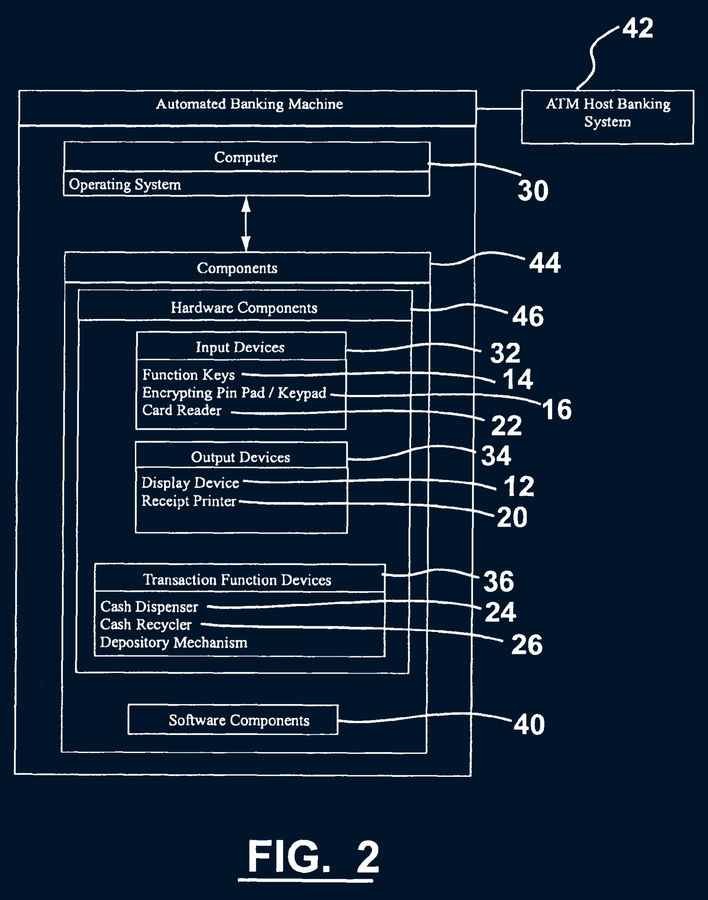
US 8,020,759 — the anti-black-box patent. The dispenser, locked inside the safe, checks cryptographically that the order to pay out really came from the bank and not from a laptop someone has just wired to it.
Diebold Incorporated, granted 2011 · read the patent
For the first two decades the controller ran a proprietary real-time operating system on custom hardware, which is an underrated security property: there was nothing to attack with, because there was no general-purpose computer in the machine. That ended with the move through OS/2 to Windows, and the arrival of CEN/XFS — a standard interface to the dispenser, reader and pad that finally let a bank run one application across several vendors' hardware.
XFS is the hinge. It made multi-vendor estates possible, and it made the black-box attack possible, because it defined a documented way to ask the dispenser for money. The countermeasure is for the dispenser to stop trusting the PC above it and cryptographically authenticate every instruction — which is what the anti-black-box patents describe.
- 1970s-1990sProprietary RTOS, custom hardware interfaces
- 1990s-2000sOS/2 → Windows NT/2000 transition. Vendor-specific: Diebold CS Gold, NCR APTRA
- 2000s-2010sWindows XP Embedded dominant. CEN/XFS standard enables multi-vendor
- 2010s-2020sWindows 10 IoT. Cloud management platforms emerge
- 2020s-presentWindows 11 IoT Enterprise. Cloud-native: NCR AMP, DN Vynamic, Hyosung BlueVerse. API-first architecture
Journal Printer
The machine's own account of what it did — and for decades, the evidence in any dispute.
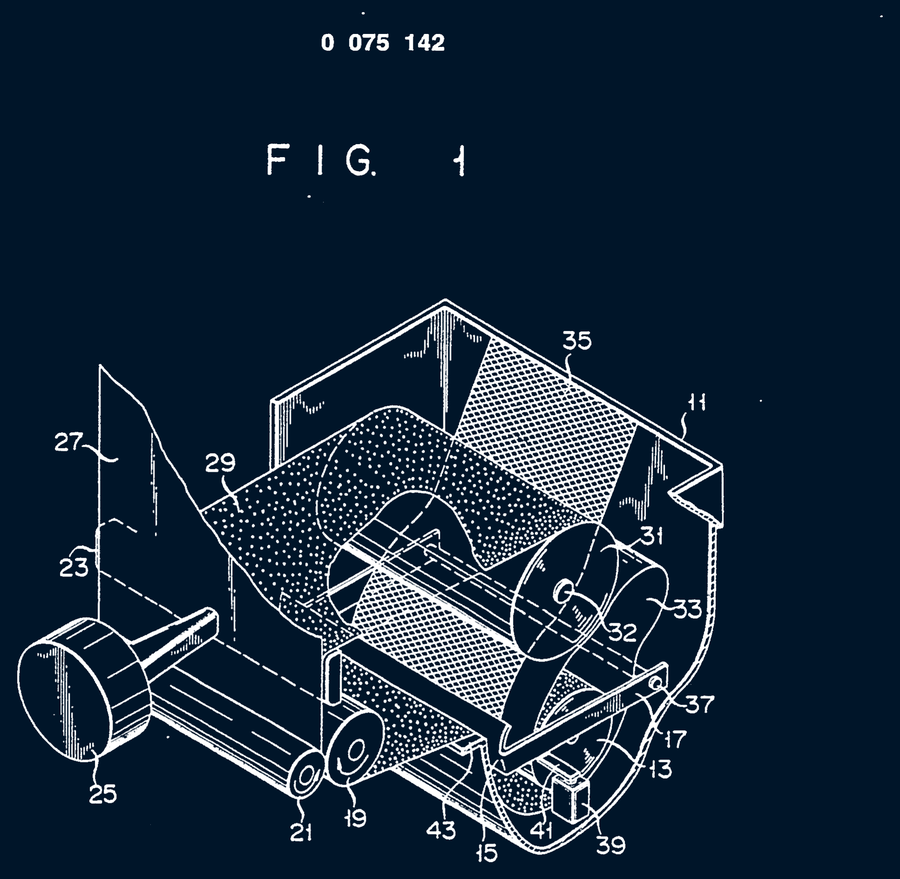
EP 0,075,142 — Double journal roll feed. Two paper rolls running through one print head, so the machine's record of itself does not stop when one of them runs out.
IBM and Tokyo Electric, granted 1987 · read the patent
The journal is the ATM writing down what happened. When a customer said the machine had not paid out and the bank said it had, the paper roll inside the machine was what settled it, which made the journal printer a legal instrument as much as a peripheral — and made a jammed one a genuine problem.
It went electronic, and the physical module largely disappeared into storage and the network. What did not disappear is the underlying question of whose record is authoritative, which is the same question the anti-black-box work is answering in a different register.
- NCRATM integrator with in-house receipt-printer engineering (POS printer heritage); consumables via Systemedia1st gen (1977 NCR 770) through 5th gen · high (corpus primary captures for SelfServ claims); medium for 2ST/RealPOS lineage
- Diebold (incl. InterBold JV with IBM, 1990s)ATM integrator; engineered its own journal-printer supervision (paper-feed fault detection)2nd–3rd gen · high (USPTO patent record)
- Wincor Nixdorf (Siemens Nixdorf heritage; now Diebold Nixdorf)ATM integrator with its own family of needle (dot-matrix) and thermal printer modules2nd–4th gen · medium (aftermarket part listings for ND/NP/TP families); high for ProCash 2000 claim (corpus primary)
- Hitachi-Omron Terminal SolutionsOEM module supplier — sells printer modules (alongside card readers, finger-vein readers) for third-party integration3rd–4th gen (captures 2009–2010; pages archived through 2020) · high (corpus primary captures of hitachi-omron-ts.com)
- OKI (Oki Electric Industry / OKI Data)Dot-matrix printing heritage (Microline line) and full-ATM maker (cash-recycling ATMs for Japan since 1982; ATM-Recycler G7 2009, G8 2017). NOT evidenced as a receipt-mechanism supplier to other ATM makers.2nd gen (Japan recyclers, 1982) through 5th gen (G8, emerging markets) · medium (vendor press releases and corporate history via search; oki.com history page itself returned 403)
Who buys from whom (5)
- third-party ATM/kiosk integrators (unnamed) buys from Hitachi-Omron Terminal SolutionsPBM BH188S-S / PEM BH180A-S impact dot-matrix passbook printer modules (RS232C/USB 'for versatile connection with the host')high that modules were sold for integration; no named customer verified
- Wincor Nixdorf ProCash ATMs buys from Wincor Nixdorf (in-house ND/NP needle and TP thermal printer families)ND98/ND98D/NP06 journal printers; ND9E/ND9A/NP07 receipt printers; TP07 thermal receipt printermedium (part-number families from aftermarket listings; in-house origin inferred from Nixdorf part numbering)
- NCR SelfServ ATMs/ITMs buys from NCR (in-house, shared with RealPOS retail printer line)2ST two-sided thermal receipt printer; dual-roll thermal receipt printersmedium (NCR datasheet + NCR-branded ATM part numbers, e.g. 009-0032473, 009-0026666)
- IBM / Embross boarding-pass kiosks (adjacent self-service market) buys from Swecoin (TTP 2100)Thermal ticket printerlow (single secondary source, kioskindustry.org retrospective)
- Gilbarco Veeder-Root outdoor payment terminals (adjacent unattended-payments market) buys from Hengstler (eXtendo X-56 / X-80)Direct thermal receipt printersmedium (Hengstler's own case statement)
Vault & Safe
Strip away the electronics and the bottom half of an ATM is a safe, made by people who have made safes since the 1800s.
Wincor's Tresor für Geldautomaten. Everything above it is electronics; this is the part that is simply a safe, and it is rated as one.
Wincor Nixdorf
The oldest technology in the machine, and the one with the longest corporate memory. The manufacturing registry behind the companion globe reaches back to Chubb's Wolverhampton works in 1818 and Sargent & Greenleaf from 1857, and those names are in an ATM story because the bottom of a cash machine is a rated safe with a certified lock on it — a specialism with its own makers, its own standards and its own century of practice.
Two things drive its evolution. Locks became electronic and auditable, with one-time combinations issued centrally so a cash-in-transit crew can open a specific safe once, at a specific time, without anyone holding a reusable secret. And attackers escalated: Europe's gas-attack epidemic produced safes designed with blow-out vents, engineered on the assumption that the safe will be filled with explosive gas and that the job is to survive the blast rather than prevent it.
25 of the 29 images on this page are archival; the remaining 4 are illustrations, and every one of them says which it is.
Archival means a real historical document or a real photograph of a real machine. The patent sheets are rendered from the original filings — public domain, inverted white-on-navy for this schematic but otherwise untouched — and each one links to the patent so the drawing can be checked against the source. The product photographs come from an archive of manufacturers' own websites going back to the late 1990s.
Illustration means an image generated for this project from one of those archival photographs. They are here because they read well against the rest of the page, and they are marked on the image, in the thumbnail strip and in the caption, because a rendering is not evidence of anything.
The supply-chain claims carry their own confidence grades, shown next to each one. “High” generally means a primary document — a filing, a patent, a manufacturer's own technical bulletin. “Medium” often means part-number forensics: an aftermarket cross-reference tying one company's part number to another company's module, with no statement from either. Vendor and trade-association material was treated as advocacy rather than as a source of record.
Three parts — the fascia, the safe and the controller — have no dedicated supply-chain study behind them yet, so they are written from the patent record, the platform history and the manufacturing registry instead, and say so.